
How Schema Markup Helps eCommerce Products Show Up in AI Answers

If you’re running an eCommerce store in 2026, you’re no longer just optimizing for search engines—you’re optimizing for AI-driven answers.
When users ask questions like:
- “Best black running shoes size 10”
- “Affordable Nike running shoes with good reviews”
AI systems don’t just pull links—they synthesize answers.
And that’s where schema markup comes in.
But let’s be clear from the start:
Schema markup alone will NOT get your products into AI answers.
But when used correctly, it becomes a powerful amplifier of visibility, accuracy, and trust.
This guide breaks down exactly how schema fits into the bigger picture—and how to use it strategically in your AI SEO Strategies.
TABLE OF CONTENT
Share This Post
Don't Have Time to Read This Looooong Blog Post? Listen to the audio podcast version.
What Is Schema Markup (and Why It Matters for AI)?
Schema markup is structured data that helps search engines and AI systems understand your content more clearly and helps with technical SEO improvements.
For eCommerce, this usually includes:
- Product name
- Brand
- Price
- Availability
- Reviews
For example, instead of guessing what your page is about, schema tells AI:
“This is a product. Here’s the price. Here’s the brand. Here’s the rating.”
Platforms like Google use this data to power:
- Rich results
- Shopping listings
- AI Overviews
How Important Is Schema for AI Inclusion?
Let’s be honest—schema is important, but not the main ranking factor.
Real Impact Breakdown:
- Content clarity & relevance → 60–70%
- Authority & trust signals → 20–30%
- Structured data (schema) → 10–15%
That means:
- You can rank without schema
- But you won’t maximize visibility without it

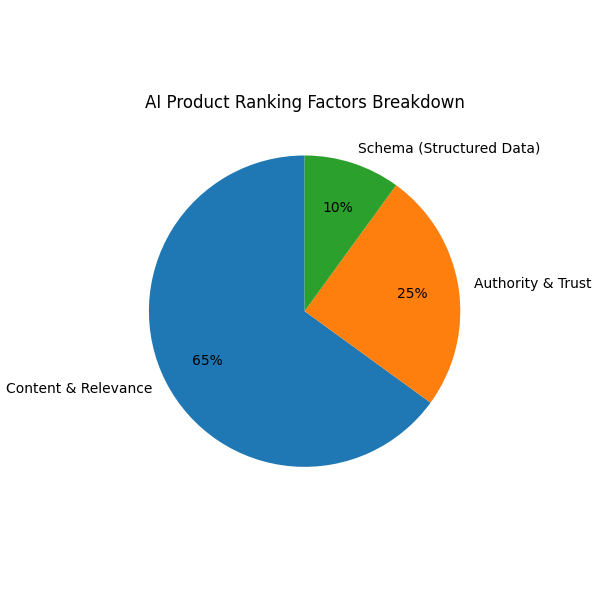
Relative influence of content, authority, and structured data in AI-driven product visibility
Source: Google Search Central documentation (structured data + ranking systems). Industry studies from SEMrush and Ahrefs on ranking factors
How Schema Helps eCommerce Products Show Up in AI Answers
1. Improves Data Accuracy
AI systems extract product details like:
- Price
- Size
- Color
- Availability
Schema ensures those details are:
- Consistent
- Machine-readable
- Less likely to be misinterpreted
2. Reduces Ambiguity
Without schema:
- AI has to interpret content
With schema:
- AI gets direct confirmation
Example:
- “Black Nike shoes” (ambiguous)
- Schema → Brand = Nike, Color = Black, Size = 10
3. Increases Eligibility for Enhanced Results
Schema helps your products appear in:
- Product carousels
- Rich snippets
- AI-generated summaries
This is especially important for competitive product searches.
4. Acts as a Tie-Breaker
If two product pages are similar:
The one with better structured data often wins
What Schema DOES NOT Do
❌ Schema does NOT make up for weak content
If your product page:
- Has thin descriptions
- Lacks reviews
- Doesn’t match search intent
You won’t show up in AI answers—schema or not.
The Winning Formula for AI Visibility
To consistently show up in AI-driven results, your product pages need:
1. Clear, Intent-Matching Content
Your product title should include:
- Brand
- Model
- Key attributes
Example:
Nike Air Zoom Pegasus Running Shoes – Black (Men’s Size 10)
2. Structured Product Information
Include:
- Bullet-point highlights
- Detailed descriptions
- Use cases (running, training, casual)
3. FAQ Content (AI Goldmine)
Answer real user questions like:
- “Does this shoe run true to size?”
- “Is this good for long-distance running?”
AI systems LOVE this format.
4. Reviews & Social Proof
User-generated content increases:
- Trust
- Authority
- AI confidence
5. Schema Markup (The Amplifier)
Add:
- Product schema
- Offer schema
- Review schema
This ties everything together.
Advanced Strategy: Combining Content + Schema
Here’s where most stores fail:
They either:
- Focus only on content
- Or blindly implement schema
The real advantage comes from combining both
Example:
Weak Page:
- Generic description
- No FAQs
- Has schema
Strong Page:
- Optimized title
- Detailed description
- FAQs
- Reviews
- Schema
The second page wins every time.
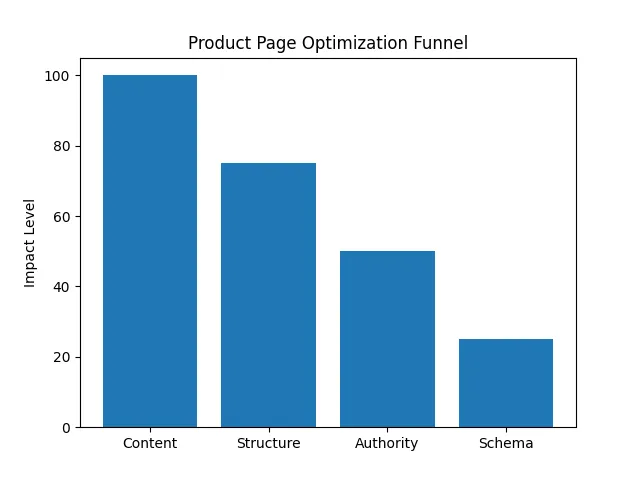
The hierarchy of optimization layers needed for eCommerce products to succeed in AI-driven search environments
Source: Google documentation on helpful content & structured data. SEO correlation studies (SEMrush, Ahrefs)
Action Plan for eCommerce Stores
If you want your products to show up in AI answers:
Step 1: Fix Your Product Titles
Make them descriptive and intent-driven
Step 2: Add Scannable Content
Use bullet points and structured sections
Step 3: Include FAQs
Target real buyer questions
Step 4: Add Reviews
Build trust signals
Step 5: Implement Schema
Use Product + Offer + Review
The Takeaway... Without the Proper Markup, Ai Will Pass Your Site By.
Schema markup is not a magic bullet—but it is a competitive advantage.
If your goal is to get your products into AI-generated answers, you need to think bigger:
- Write content that matches real search intent
- Build authority and trust
- Structure your data for machines
Then use schema as the final layer that amplifies everything else
Because in today’s search landscape:
The winners aren’t just optimized for search engines…
They’re optimized for AI understanding.
Download our guide
Learn how to structure
your LLMs.txt file
Similar Reads





Alexander Robinson III
Alexander Robinson has spent more than 25 years building deep expertise in SEO and digital marketing strategies. Before starting Smart Target Digital, His experience includes consulting, project management, and stints as SEO Managers and Specialists. Fast-forward to the present, He's helped clients across MANY industries increase traffic, improve Search positions, scale leads, and raise sales by implementing SEO growth strategies structured for Ai recognition.
"If you want to survive as an SEO, you have to adapt or die. I choose to adapt"
- Alexander Robinson- Founder of Smart Target Digital
Ready to reach your target audience? Let's talk!
Get started by requesting a 30 minute meeting to discuss your goals and learn how our Streaming Ads, SEO, and Brand Awareness Strategies can help.




FAQ's
Have more questions? Check our
faq's to gain more insight.