

How Press Releases Help Create Authority and Trust for AI

As AI-powered search continues to reshape how users discover information, digital marketers and business owners are facing a new challenge: how to become a trusted source in AI-generated answers.
Unlike traditional SEO, where rankings were heavily influenced by keywords and backlinks alone, AI engines evaluate content differently. They prioritize authority, consistency, entity recognition, and cross-source validation.
This raises an important question:
Do press releases actually help your brand show up in AI answers?
The answer is yes—but not in the way most people think.
Press releases are not a direct ranking factor for AI systems. However, when used strategically, they play a powerful role in building the signals AI engines rely on to determine trust and authority.
In this guide, we’ll break down exactly how press release distribution fits into AI SEO—and how to use it to your advantage.
TABLE OF CONTENT
Share This Post
Don't Have Time to Read This Looooong Blog Post?Summarize with AI
Want to get straight to the point? Choose which open AI Search platform you want to use to explore this topic and understand how the Smart Target Digital mind works. Even Share it on LinkedIn!
To understand the value of press releases, you first need to understand how AI engines evaluate content.
AI systems don’t simply pull information from one source. Instead, they analyze patterns across multiple signals, including:
- Domain authority and credibility
- Consistency of information across sources
- Brand mentions and citations
- Topical authority and expertise
- Structured and machine-readable content
In other words:
AI doesn’t trust what you say—it trusts what the internet consistently says about you.
This is where press releases begin to play a role.
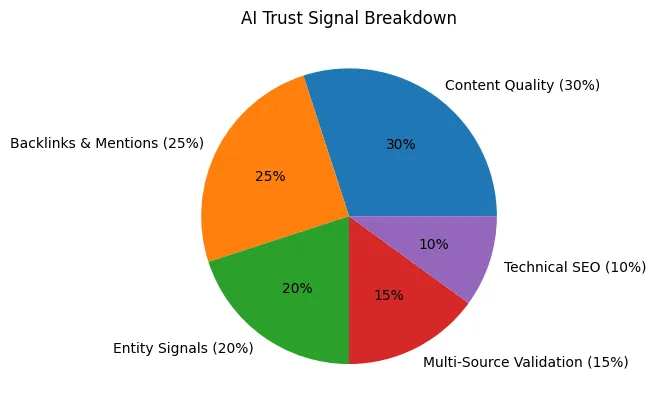
Key factors influencing AI trust and content selection
Source: Google Search Quality Evaluator Guidelines, Industry SEO studies (Moz, Ahrefs, SEMrush)
What Press Releases Actually Do (And Don’t Do)
Let’s clear up a common misconception.
What Press Releases Don’t Do
- They don’t directly improve AI rankings
- They don’t instantly make your content authoritative
- They don’t guarantee visibility in AI answers
What Press Releases Actually Do
- Distribute your brand across multiple sources
- Reinforce consistent messaging
- Create opportunities for backlinks and mentions
- Strengthen entity recognition
Think of press releases as signal amplifiers, not ranking drivers.
How Press Releases Support AI Trust Signals
1. Entity Recognition and Knowledge Graph Building
AI engines rely heavily on entity-based understanding. This means they identify your business as a distinct “entity” and associate it with specific topics.
When your brand appears across multiple publications with consistent information:
- Your business becomes easier to recognize
- Your expertise becomes clearer
- Your relevance to certain topics strengthens
This contributes to how AI builds knowledge graphs.
2. Multi-Source Validation (One of the Most Important Signals)
One of the strongest trust signals in AI systems is confirmation across multiple sources.
When a press release is distributed:
- Your content appears on multiple domains
- Your messaging is repeated and reinforced
- AI systems see alignment across sources
This creates what is known as multi-source validation.
The more consistent your message across credible platforms, the more AI trusts it.
3. Secondary Backlinks and Citations
The real value of press releases is not the initial distribution—it’s what happens after.
Press releases can lead to:
- Editorial backlinks
- Blog mentions
- Media coverage
- Industry citations
These secondary signals are far more valuable than the press release itself.
AI engines prioritize these because they indicate independent validation.
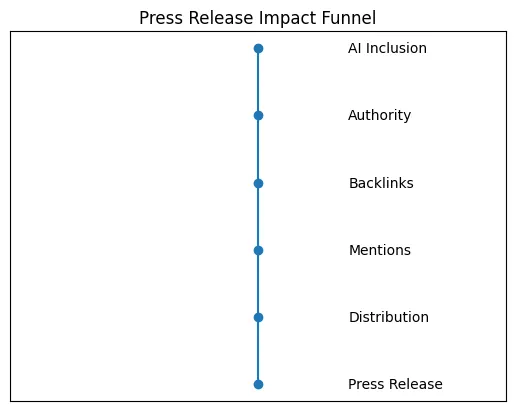
Press Release → Distribution → Mentions → Backlinks → Authority → AI Inclusion
Source: Aggregated SEO strategy frameworks
4. Topical Authority Reinforcement
If your press releases consistently focus on a specific subject area (like AI SEO, digital marketing, or CTV advertising), you begin to build topical authority.
This helps AI systems understand:
- What your brand specializes in
- What topics you should be trusted on
- Where your expertise lies
Over time, this increases your likelihood of being included in AI-generated answers.
Why Publishing a Press Release for Every Blog Is a Mistake
It might seem logical to create a press release for every blog post—but this approach can backfire.
Here’s why:
- It dilutes the perceived value of your content
- It signals low-quality or spam-like behavior
- It reduces the likelihood of media pickup
- It creates repetitive, low-impact signals
AI systems are sophisticated enough to detect patterns.
Repetition without meaningful variation = low trust signal
The Right Strategy: Quality Over Quantity
Instead of publishing press releases for every piece of content, focus on strategic amplification.
Ideal Approach:
- Publish 8–12 high-quality blog posts per month
- Select 2–4 of the strongest pieces
- Convert those into press releases
What Makes a Press Release “AI-Worthy”
Not all press releases are created equal.
To support AI visibility, your press release should include:
1. Data or Unique Insights
- Studies
- Trends
- Analysis
2. Original Frameworks or Strategies
- New methodologies
- Proprietary systems
3. Case Studies or Results
- Measurable outcomes
- Real-world examples
4. Timely Industry Relevance
- AI updates
- Search engine changes
- Market shifts
The Content Ecosystem That Drives AI Visibility
The most effective strategy isn’t just about press releases—it’s about building a connected ecosystem.
Here’s what that looks like:
- Blog Post (Primary Source) - In-depth, authoritative content
- Press Release (Amplifier) - Distributes key insights
- Backlinks & Mentions (Validation) - Independent references
- Internal Linking (Structure) - Reinforces topical authority
- Schema Markup (Clarity) - Helps AI understand your content
Together, these create a network of signals that AI engines trust.
Best Practices for Press Release Distribution in AI SEO
To maximize results:
- Use reputable distribution platforms
- Focus on clarity and factual accuracy
- Maintain consistent brand messaging
- Avoid keyword stuffing
- Link naturally back to supporting content
- Align releases with broader content strategy
The Takeaway...
Press releases are often misunderstood in modern SEO—especially in the context of AI.
They are not shortcuts to rankings, nor are they standalone solutions for visibility.
Here at Smart Target Digital, we use press releases strategically as a powerful tool for:
- Reinforcing your brand’s authority
- Creating multi-source validation
- Generating backlinks and citations
- Supporting entity recognition
In an AI-driven search landscape, trust is built through consistency, authority, and validation across the web.
Press releases help you achieve exactly that—when they’re part of a larger, intentional strategy.
Related Articles
Download Our Guides
Content Categories
Solutions
Ready to reach your target audience? Let's talk!
Get started by requesting a 30 minute meeting to discuss your goals and learn how our Streaming Ads, SEO, and Brand Awareness Strategies can help.



FAQ's
Not directly. They support the signals that AI engines use to determine trust and authority.
Share This Post