

Programmatic SEO and Page Templates: How to Scale Your Website Without Sacrificing Quality
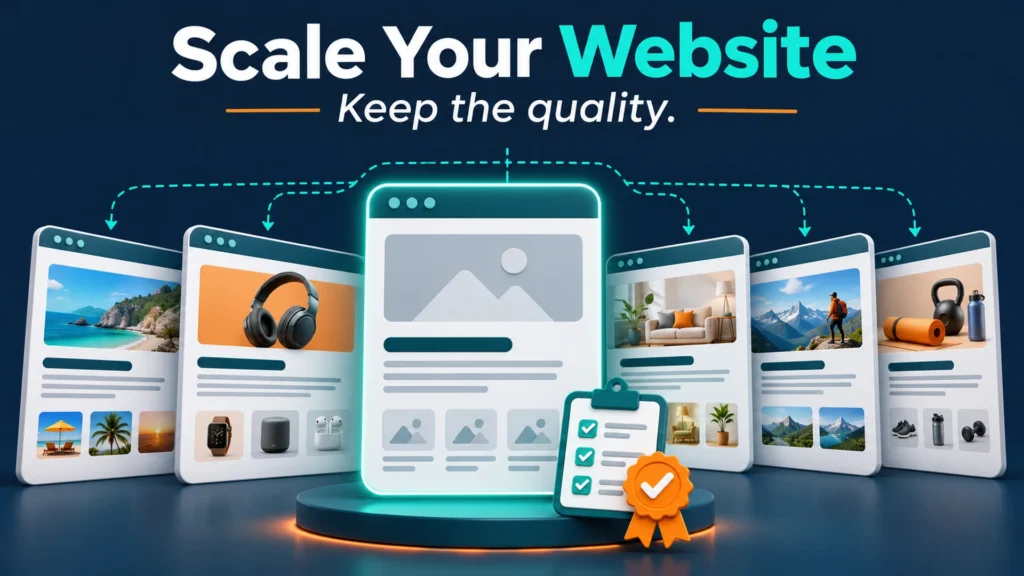
Your website needs room to grow. Perhaps you’re adding products, expanding into new markets, or managing a collection of vacation rentals. Creating every page from scratch quickly becomes expensive. Copying existing pages and changing a few words creates a different problem: a larger website with little additional value.
Programmatic SEO combines reliable data, reusable page templates, and automation to create useful pages for related search needs. Done well, it reduces repetitive work while preserving the information that makes each page worth visiting.
The opportunity is straightforward: build a repeatable system that helps more customers find the right answer. Here’s how to approach it without letting quality slip.
TABLE OF CONTENT
- What is programmatic SEO, and how do page templates fit in?
- What technical SEO checks should happen before launch?
- What are the main benefits of programmatic SEO?
- How do SEO page templates improve consistency?
- Which businesses benefit most from this approach?
- How can you scale content without producing thin pages?
- Can programmatic pages support visibility in AI answers?
- How should you launch and measure a programmatic SEO project?
- The Takeaway
Share This Post
Don't Have Time to Read This Looooong Blog Post? Listen to the audio podcast version.
What is programmatic SEO, and how do page templates fit in?
Programmatic SEO is a method for creating and maintaining search-focused pages from organized data. Page templates provide the structure; individual records supply the details.
For a vacation rental website, a template might contain sections for guest capacity, bedrooms, amenities, photographs, and booking information. Each property supplies its own facts. The design stays consistent while the content changes meaningfully.
Templates also work without automation. A business can manually populate ten service pages using one layout. Programmatic SEO adds rules and data connections that make larger publishing projects manageable.
One distinction matters: structured business data means organized information, such as spreadsheet records. Structured data markup means machine-readable annotations, such as JSON-LD. They serve different purposes, although a publishing system can use both.
Download our guide
Learn how to structure
your LLMs.txt file
Similar Reads



What technical SEO checks should happen before launch?
Check whether search engines can discover, render, and index the intended pages—and whether visitors can use them comfortably.
Understanding why technical SEO improves search engine rankings helps explain why publishing alone is insufficient.
Review these essentials:
- Indexability: Important pages return successful responses and have no unintended indexing restrictions.
- Discovery: Crawlable internal links connect pages to relevant categories and resources.
- Canonicalization: Preferred URLs align across internal links, sitemaps, and canonical tags.
- Rendering: Essential information appears reliably when pages load.
- Performance: Images, scripts, and layouts work well on mobile devices.
- Markup: Applicable schema describes the content visitors actually see.
Follow Google’s canonical URL guidance for duplicate or very similar pages. Canonical tags are signals, not a repair for weak content. Don’t point distinct pages to one parent page if you want each considered independently.
What are the main benefits of programmatic SEO?
The benefits of programmatic SEO include broader search coverage, more efficient production, easier updates, and landing pages that better match specific customer needs.
A visitor searching for a large-group rental with a private pool needs different information from someone browsing general travel advice. A relevant collection page can bring matching properties and practical guidance together.
For businesses, this approach can provide:
- More relevant entry points: Pages address distinct products, locations, or use cases.
- Less repetitive work: Teams reuse tested layouts and publishing rules.
- Simpler maintenance: Central records keep shared facts consistent.
- Clearer conversion paths: Visitors encounter relevant inquiries, purchases, or bookings.
Savings depend on scale. Development, data preparation, and review require investment. A small website with a few services may gain more from strong individual pages than a complex automated system.
How do SEO page templates improve consistency?
SEO page templates make important information easier to include and easier to find. Writers get a clear brief, developers maintain shared components, and visitors encounter familiar navigation.
A useful template should reserve space for:
- A specific heading and concise answer to the visitor’s main question.
- Unique facts, photographs, examples, or specifications.
- Relevant internal links and a clear next step.
- Accessible forms, descriptive image text, and readable mobile layouts.
Consistency also supports maintenance. A centrally managed template can update connected pages when a component changes. Duplicating a finished page usually creates separate copies that still need individual attention.
However, templates multiply mistakes too. An incorrect canonical setting or broken inquiry form can affect an entire page group. Test the shared structure before expanding it.
Which businesses benefit most from this approach?
Businesses with repeatable search needs and substantial, accurate information are the strongest candidates.
Ecommerce companies may have detailed product specifications. Multi-location businesses may have distinct teams, opening hours, services, and directions. Travel companies may manage property inventories. Software businesses may document real integrations and compatibility requirements.
The deciding factor is whether each proposed page helps someone make a different decision.
For example, a location page should explain what customers can actually access there. A city name inserted into generic service copy contributes little. Likewise, generating every possible combination of rental amenities can produce empty or nearly identical collections.
Start by identifying useful page opportunities, then decide which deserve their own URLs.
How can you scale content without producing thin pages?
Set minimum publication standards before generating pages. Require the information a visitor needs, and hold incomplete records back for review.
In Google’s people-first content guidance, originality, clear sourcing, and demonstrable expertise are central considerations. Apply those principles through accurate details, identifiable authors or reviewers, and evidence supporting important claims.
As Google’s Danny Sullivan wrote:
“We know people don’t find content helpful if it seems like it was designed to attract clicks rather than inform readers.”
— Danny Sullivan, Google Search commentary
A practical quality test is to remove the page’s primary keyword. Does the remaining information still help a customer? If the answer is no, the page needs more substance.
Google’s spam policies address scaled content created primarily to manipulate rankings and doorway pages targeting similar queries. Automation itself does not determine quality; purpose and usefulness matter.
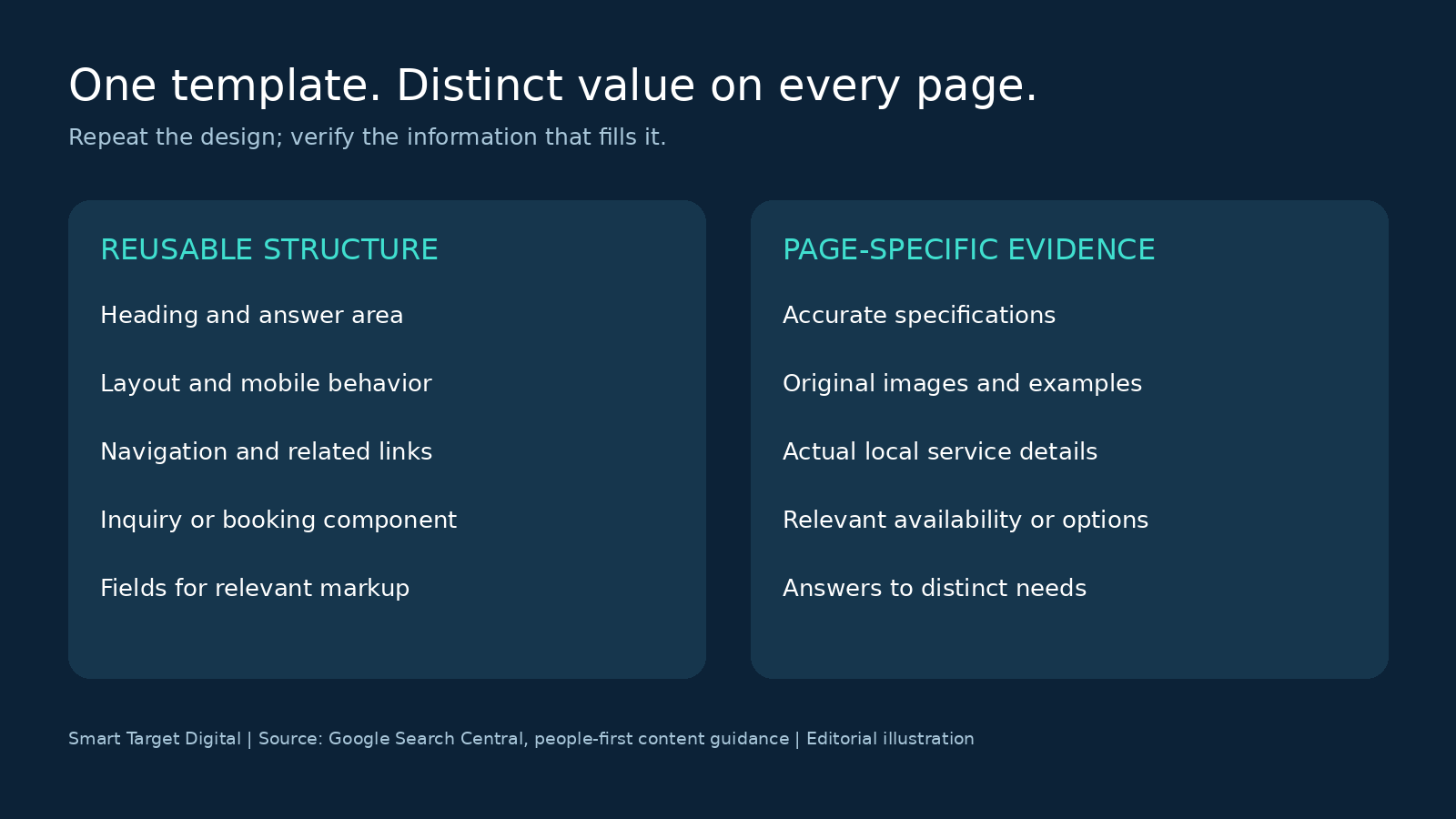
Reuse the structure while supplying distinct evidence for each page. Original Smart Target Digital editorial visual, informed by Google’s people-first content guidance.
Source: https://developers.google.com/search/docs/fundamentals/creating-helpful-content
Can programmatic pages support visibility in AI answers?
Useful, accessible pages can support AI discovery, but programmatic publishing does not guarantee citations from ChatGPT, Perplexity, Gemini, or Claude. Each platform has its own retrieval systems and access controls.
Answer engine optimization should make information easier to understand: use descriptive question headings, answer directly, explain limitations, and cite original sources. Keep important details in readable text and show who is responsible for the content.
John Mueller’s introduction to Google’s AI optimization resource emphasizes:
“valuable, unique, non-commodity content”
— John Mueller, Google Search guidance announcement
Google’s AI search guidance confirms that established SEO fundamentals remain relevant to its AI features. Question headings are a helpful editorial choice, not an eligibility requirement.
Our guide to AI SEO: optimizing for ChatGPT vs. Google explores the broader topic. Start with accurate answers and technical accessibility rather than promises of automatic inclusion.
How should you launch and measure a programmatic SEO project?
Launch a representative pilot, inspect the results, and expand only after addressing problems.
Choose examples that expose template weaknesses: records with missing optional fields, longer descriptions, different image sizes, and changing availability. Check the rendered pages and complete the conversion process yourself.
Then monitor indexing, relevant search queries, organic visits, qualified inquiries, and maintenance costs. Group results by template and page type so one successful section doesn’t hide another section’s problems.
Record publication dates and changes. Search demand, seasonality, and other marketing activity can influence results, so a traffic increase alone does not prove the template caused it.
Assign ownership for data updates and retirement rules. A scalable website needs a plan for outdated products, closed locations, and empty collections as well as new pages.
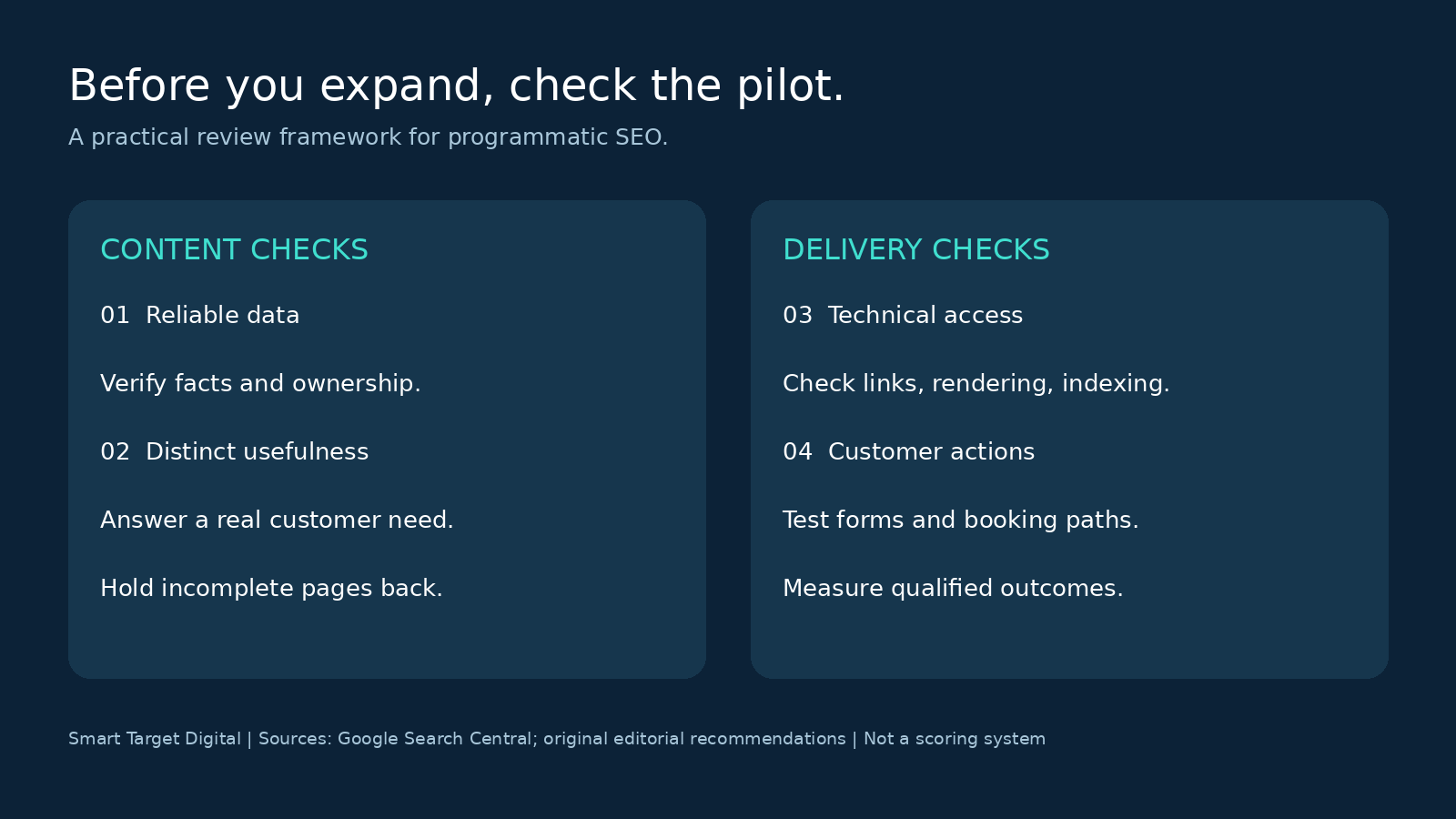
Original editorial checklist informed by Google Search Central guidance; not an official standard or scoring model.
The Takeaway... Is your website ready to scale without sacrificing quality?
Programmatic SEO works best when the business has something useful to scale: reliable information, distinct customer needs, and a process for keeping pages accurate. Templates make that work repeatable; editorial judgment keeps it valuable.
Before investing, assess your data, existing content, technical foundation, and conversion goals. The right outcome may be an automated publishing system, a better template, or improvements to current pages.
Ready to find out what fits your website? Explore Smart Target Digital’s SEO and AI optimization services, then schedule a consultation to discuss your website’s opportunities and a practical path forward.

Alexander Robinson III
Alexander Robinson has spent more than 25 years building deep expertise in SEO and digital marketing strategies. Before starting Smart Target Digital, His experience includes consulting, project management, and stints as SEO Managers and Specialists. Fast-forward to the present, He's helped clients across MANY industries increase traffic, improve Search positions, scale leads, and raise sales by implementing SEO growth strategies structured for Ai recognition.
"If you want to survive as an SEO, you have to adapt or die. I choose to adapt"
- Alexander Robinson- Founder of Smart Target Digital
Ready to reach your target audience? Let's talk!
Get started by requesting a 30 minute meeting to discuss your goals and learn how our Streaming Ads, SEO, and Brand Awareness Strategies can help.



FAQ's
Have more questions? Check our
faq's to gain more insight.