

CTV vs. OTT: The Key Differences

Streaming has completely reshaped how audiences consume video content — and how advertisers reach them. But terms like OTT, CTV, Connected TV advertising, and OTT vs CTV are often used interchangeably, causing confusion among marketers, business owners, and even publishers selling ad inventory.
Although OTT and CTV are closely related, they are not the same. Understanding the difference is crucial for planning advertising budgets, predicting performance, analyzing targeting options, and maximizing ROI.
This guide breaks down OTT vs CTV in simple, actionable language — whether you’re a digital marketer deciding how to allocate budget, a local business owner new to streaming ads, or a publisher positioning your inventory for advertisers.
We’ll cover:
What OTT and CTV actually mean
Why CTV is easier and more accessible than traditional TV advertising
How OTT and CTV shape targeting, measurement, and ad performance
Why small and local businesses are rapidly shifting ad spend into streaming
The growth of ad-supported streaming (AVOD + FAST)
Strategic recommendations for marketers and publishers
Visual diagrams and charts
FAQs and schema for SEO
Let’s get started.
TABLE OF CONTENT
Share This Post
What Is OTT and What Is CTV?
Before comparing OTT vs CTV, it’s essential to understand the difference:
OTT (Over-the-Top)
OTT is the delivery method.
It refers to any video content delivered over the internet, bypassing cable or satellite providers.
Examples of OTT services include:
Netflix
Hulu
Disney+
YouTube and YouTube TV
Tubi
Pluto TV
Amazon Prime Video
OTT can be viewed on:
Smartphones
Tablets
Laptops
Desktop computers
CTV devices
CTV (Connected TV)
CTV is the device used to watch OTT content.
A CTV is any internet-connected television or device that enables streaming. This includes:
Smart TVs
Roku
Amazon Fire TV
Apple TV
Google Chromecast
PlayStation and Xbox
Set-top boxes
CTV = the big-screen experience in the living room.
Simple Analogy
OTT = the water (content)
CTV = the faucet (the device you use to access it)
You can access water from a hose, sink, or shower → You can watch OTT on mobile, laptop, or CTV.
The Relationship Between OTT and CTV
The easiest way to understand the relationship:
All CTV is OTT.
(Because you're streaming internet-delivered content on a TV.)Not all OTT is CTV.
(You can watch OTT services on your phone, laptop, or tablet.)
Why the Difference Matters for Advertising
Understanding OTT vs CTV changes your approach to:
Targeting
Budget allocation
Creative format
CPMs
Measurement
Attribution
Context
ROI
Here’s the key difference:
OTT includes all devices
CTV includes only the living-room TV screen
This creates very different advertising environments.
Aspect
CTV
OTT
What it is
Internet-connected TV device
Delivery of streaming content
Devices
Smart TVs and streaming boxes
Mobile, desktop, tablet, CTV
Viewing context
Shared, household screens
Personal screens
Targeting
Household/device-level
Individual-level IDs
Ad environment
Lean-back, high completion
Interactive, skippable
CPM
Higher (premium)
Lower
Subset?
CTV is a subset
OTT is the umbrella
Why CTV Advertising Is Easier Than Traditional TV
One of the biggest benefits for marketers — especially small and local businesses — is how simple and accessible CTV advertising is compared with traditional TV.
Traditional TV Advertising Challenges
High minimum budgets (often $20k+)
Fixed time slots
Limited targeting (age, gender, DMA)
No real-time reporting
No precise attribution
CTV Advertising Advantages
Runs on any budget (as low as $500–$2,000)
Targeting based on real data:
Household income
ZIP code
In-market buyers
Interests & behaviors
Delivery across all major apps
Reports include:
Impressions
Completion rates
Frequency
Household reach
Store visits
Website conversions
CTV democratizes access to TV-level advertising.
Why CTV & OTT Are Beneficial for Small & Local Businesses
Small businesses historically could not advertise on TV due to cost.
Streaming has changed this forever.
Why small/local businesses love CTV advertising:
You can target only your ZIP codes or radius
You pay only for impressions — not showtimes
Your ads appear on premium content like:
ESPN
Discovery
AMC
Food Network
Local news streams
It builds trust because customers associate streaming with “real TV”
Reporting is transparent
What this means for SMBs
Higher trust than social media ads
More consistent attention than mobile ads
More cost-efficient than traditional TV
Measurable results
Viewing Trends — Why CTV & OTT Are Dominating
Below is a summary of the latest industry data (2024–2025):
90% of U.S. households use CTV monthly
Streaming > Cable + Broadcast combined
73.6% of all TV time is now ad-supported
CTV ad spending projected to hit $46.89B by 2029
Hybrid ad-supported tiers like Netflix’s are booming
FAST (Free Ad-Supported Streaming TV) viewing grew 43% YoY
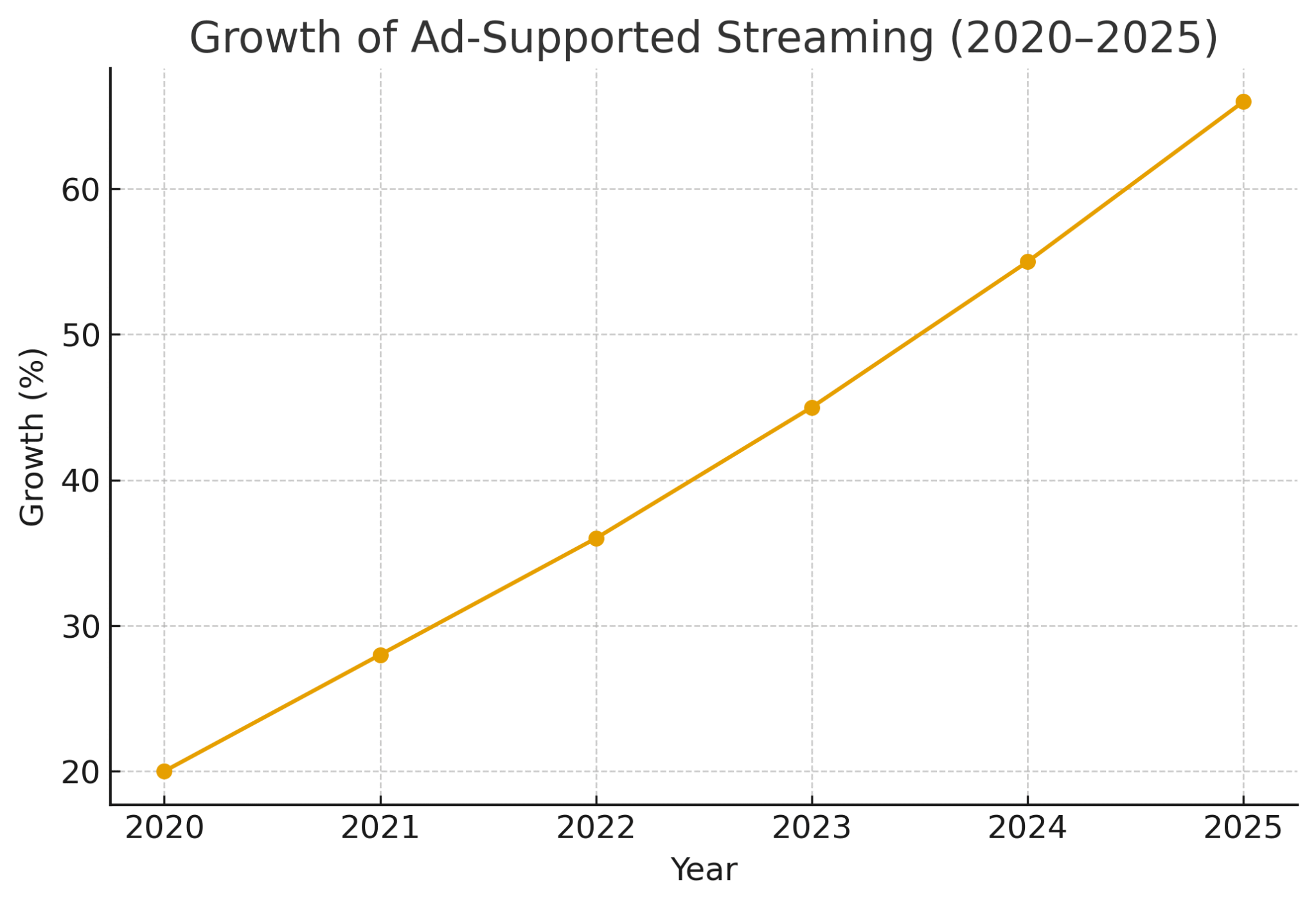
Sources: Nielsen Gauge Report 2025, eMarketer, Amazon/YouTube streaming growth reports.
Types of OTT Services (SVOD, AVOD, FAST, TVOD)
The OTT ecosystem breaks down into:
SVOD (Subscription Video on Demand)
Paid, ad-free services.
Examples: Netflix premium, Disney+ premium.
AVOD (Advertising-Based Video on Demand)
Free or low-cost, ad-supported.
Examples: Tubi, Hulu basic.
FAST Channels (Free Ad-Supported Streaming TV)
Live, linear-style channels with commercial breaks.
Examples: Pluto TV, Samsung TV Plus.
TVOD (Transactional Video on Demand)
Pay-per-view rentals or purchases.
Examples: iTunes rentals.
The Strategic Difference for Marketers (OTT vs CTV)
OTT Strategy:
Plan for all screens — mobile, desktop, TV.
CTV Strategy:
Plan specifically for the premium big-screen experience.
Most advertisers run both:
OTT (phones/tablets) → broad performance & retargeting
CTV (big-screen) → premium reach & brand lift
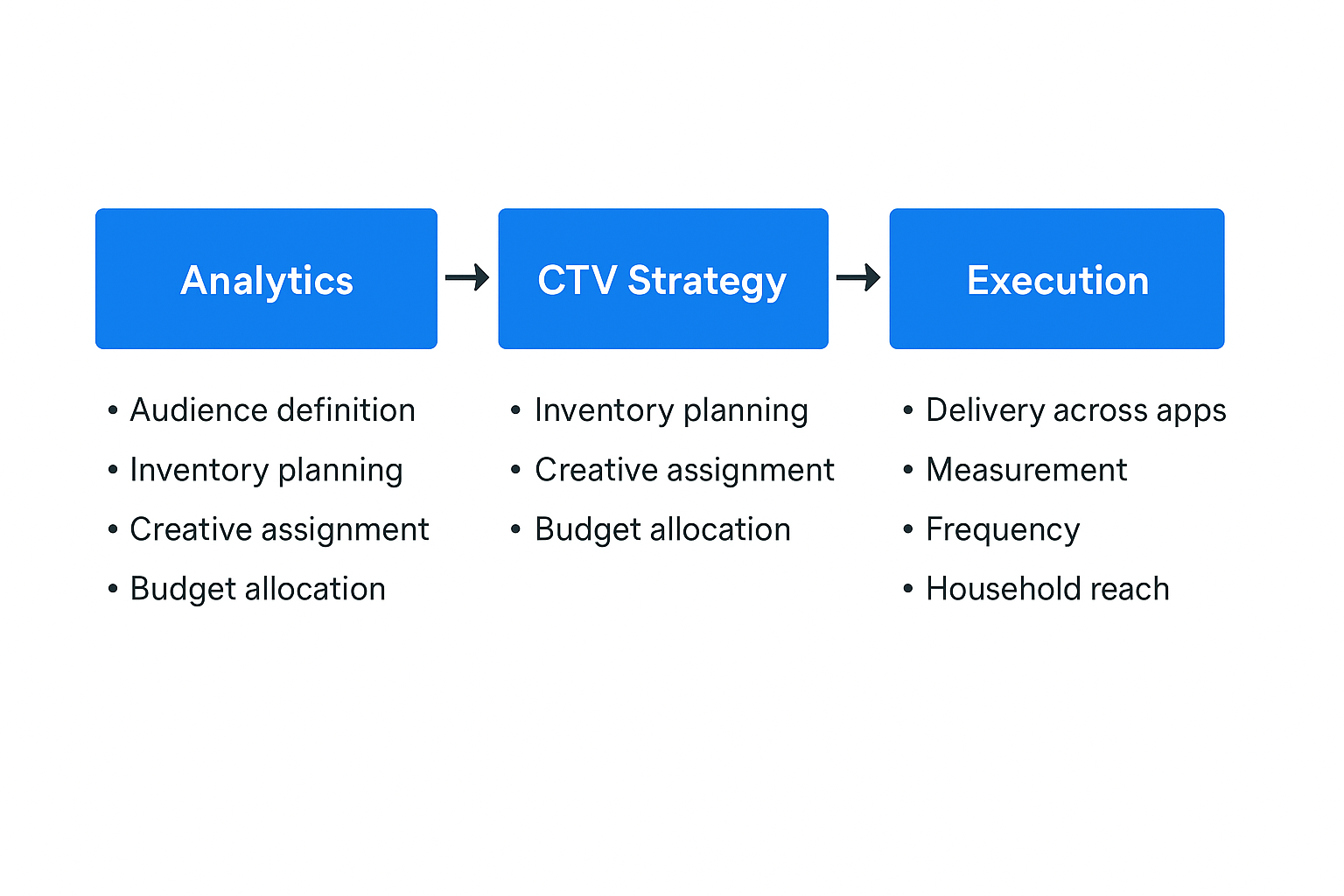
Sources: Standard DSP planning workflow.
Conclusion
OTT and CTV are deeply connected, but they serve different roles:
OTT = The delivery method
CTV = The living-room TV device
CTV is a subset of OTT
CTV ads deliver higher impact
OTT ads deliver broader reach
Small businesses benefit massively
Marketers can target precisely and measure results
Understanding this distinction helps marketers allocate budget correctly, helps SMBs choose the right channel for growth, and helps publishers package their inventory in the most valuable way.
OTT vs CTV is no longer just a terminology difference — it’s the foundation of modern video advertising.
Author of This Post

Alexander Robinson III
Founder/Director of SEO
Download Our Guides
Content Categories
Solutions




FAQ's
CTV is any internet-connected television device (Smart TV, Roku, Fire TV) that lets users stream content over the internet.
Ready to reach your target audience? Let's talk!
Get started by requesting a 30 minute meeting to discuss your goals and learn how our Streaming Ads, SEO, and Brand Awareness Strategies can help.
Share This Post